
After the 2026 Federal Budget, there is now one place in Australia where you can buy an existing residential investment property, negatively gear it, and pay no capital gains tax when you eventually sell. That place is superannuation — specifically, a Self-Managed Super Fund (SMSF).
This is not a loophole. It is not a grey area. The Budget explicitly carved SMSFs out of the new negative gearing restrictions, and the capital gains tax discount inside super has been left unchanged. For anyone with a reasonable super balance and a long-term investment horizon, this changes the calculus on property ownership significantly.
This guide covers exactly how it works — what you need to get started, how the borrowing structure operates, what the real tax advantage looks like in dollar terms, and the risks that are genuinely worth understanding before you proceed.
Already know the background and want to talk numbers for your specific situation? See our SMSF property page or call us directly on 1300 651 263.
Navigate to Key Sections
What the 2026 Budget actually changed for property investors
From 1 July 2027, negative gearing on newly acquired existing residential properties is restricted for individuals, partnerships, companies, and most trusts. Losses can only offset rental income or capital gains from the same property — they can no longer offset salary or other income.
The 50% CGT discount for individuals has been replaced by a cost-base indexation method (adjusting only for inflation) plus a 30% minimum tax floor on real gains.
SMSFs — and all complying superannuation funds — are explicitly excluded from both changes.
The result, as described by Colin Lewis, Head of Strategic Advice at Fitzpatricks Advice Partners: “The budget has created the single largest tax wedge between super and personal investing under tax law.”
An investor selling a property in their own name faces at least 30% tax on real gains. The same asset sold in an SMSF in pension phase attracts no tax at all — provided the member’s total super balance is below the transfer balance cap (currently $2 million).
For a detailed breakdown of the Budget changes and how Grow SMSF positions this, read our earlier piece: SMSFs: Preferred Property Investment Structure After the 2026 Budget.
The tax advantage in dollar terms
Consider a straightforward scenario: a $1 million residential property purchased inside an SMSF, held for 10 years, then sold for $2.5 million. The entire transaction occurs after 1 July 2027 under the new CGT regime.
Personal ownership (top marginal rate)
Under the new indexation method, even with no other income, the $1.5 million gain would push the individual into the 47% tax bracket. Tax payable: approximately $573,400. They bank approximately $926,600 of their $1.5 million gain.
SMSF in accumulation phase (balance over $3 million)
The SMSF pays 10% effective tax on the gain (15% rate with 33.33% discount), plus Division 296 tax if the member’s total super balance exceeds $3 million. Total tax: approximately $187,500. They bank approximately $1.31 million — a 34% better outcome than personal ownership.
SMSF in pension phase (balance under $2 million transfer balance cap)
The fund pays no tax on the sale. Tax on the gain: $0 on the pension-phase portion (subject to transfer balance cap). Total tax: approximately $112,500 (including Division 296 on assets above the cap). They bank approximately $1.39 million — a 40% better outcome than personal ownership.
These figures are illustrative. They assume Division 296 is in place, that the transfer balance cap threshold is frozen, and that the new CGT discount method applies for the full holding period. Actual outcomes depend on your balance, contributions, and sale timing. But the structural advantage is permanent and material.
What you need to get started
A minimum super balance of $200,000–$300,000
The deposit for an SMSF property purchase (typically 20–30% of the property value) must come from your super balance. With the median capital city property price sitting above $1 million, you need at least $200,000 to consider this strategy — and most lenders will want to see closer to $300,000, plus a liquidity buffer.
At Grow, our general guidance for clients considering SMSF property is:
- $200,000: Minimum threshold — possible, but tight. Suitable only for lower-value properties in specific markets.
- $300,000: The practical minimum most lenders will accept at standard LVR terms.
- $400,000–$500,000: Recommended if you want diversification alongside the property. Holding 90–100% of your fund in a single residential property is not prudent investment practice.
For couples with separate super balances, these figures apply to the combined balance of a two-member fund.
The SMSF must be set up first
This is worth stating plainly because it is one of the most common errors we see: you cannot set up an SMSF after you have found a property and signed a contract. The fund must exist, have a TFN and ABN, have a bank account open, and have sufficient funds available before you can commit to any purchase.
If you are at the stage of actively looking at properties, the time to set up your SMSF is now, not after you find the right one. SMSF establishment takes 4–6 weeks from start to first transaction. Auctions do not wait.
Set up your SMSF online with Grow →
A cash buffer inside the fund
The property must be maintained entirely from fund assets. If the hot water system fails, the tenant vacates unexpectedly, or you need to bridge a gap in loan repayments — that money must come from within the SMSF. You cannot top it up from personal funds without making a formal super contribution, which is subject to contribution caps.
A practical cash buffer of 5–10% of the property value held in the fund’s transaction account is the standard recommendation. This is separate from your deposit and loan serviceability calculations.
How SMSF property borrowing works — the LRBA structure
SMSFs cannot borrow money through a standard investment loan. Property purchases using borrowed funds inside an SMSF require a Limited Recourse Borrowing Arrangement (LRBA).
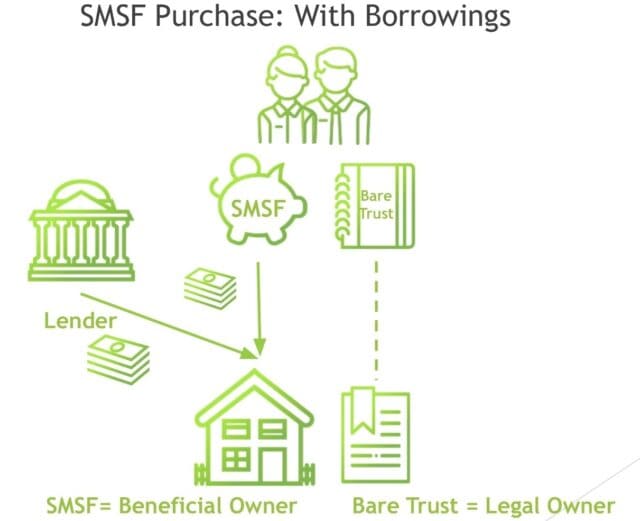
The key features of an LRBA:
- The property is held in a separate bare trust (custodian trust) until the loan is repaid — it does not sit directly in the SMSF during the loan term
- The lender’s recourse is limited to the property itself — if the SMSF defaults, the lender cannot pursue other fund assets
- Once the loan is fully repaid, the property transfers from the bare trust into the SMSF
- You cannot use borrowed funds to improve the property (renovate) — only to repair or maintain it. You can renovate, but only using the fund’s own cash, not loan proceeds.
- You cannot fundamentally change the character of the asset while the loan is in place — no subdivision, no demolition and rebuild
The major banks exited the SMSF LRBA market several years ago. Current SMSF loans are available through second-tier banks and specialist non-bank lenders. Interest rates for residential SMSF loans are currently in the low-to-mid 7% range for 70–80% LVR products.
Grow has established relationships with SMSF lending specialists and can facilitate introductions as part of our property setup service. We also handle the bare trust establishment, which is a separate legal structure — and a separate cost — that must be in place before the property can settle. See our full guide: SMSF Bare Trust explained.
State-by-state note on bare trust timing
In some states the bare trust must be established before you sign a contract of sale. In others, it can be established before settlement. This is not a minor procedural point — getting it wrong can mean the property is acquired in the wrong name, which is an illegal SMSF borrowing arrangement and cannot be unwound without selling the property.
If you are seriously considering an SMSF property purchase, speak to us before you make any offer. This is exactly the type of situation where a quick phone call prevents an expensive, unrecoverable mistake.
The sole purpose test and what the property cannot be used for
Every SMSF investment must pass the sole purpose test — its purpose must be to provide retirement benefits to fund members. For residential property, this means:
- No fund member or related party can live in the property (even short-term)
- The property cannot be used as a holiday home by a member or related party
- The property cannot be acquired from a related party — you cannot transfer a residential property you personally own into your SMSF
- The property is an investment asset, rented at arm’s length to unrelated tenants
Commercial property is treated differently — an SMSF can purchase a business owner’s commercial premises and lease it back at market rates. This is a well-established strategy that remains unaffected by the 2026 Budget changes. But for residential property, the rules above apply strictly.
Negative gearing inside super: how it actually works
SMSFs retain full negative gearing on both new and existing residential properties acquired after Budget night. This means:
- If the fund’s rental income is less than the interest, expenses, and depreciation on the property, the fund runs a tax loss
- That loss reduces the fund’s taxable income — at the fund’s 15% tax rate
- Unused losses carry forward to future years
The honest point: because the SMSF tax rate is already only 15%, the benefit of negative gearing inside super is materially smaller than it was for high-income individuals under the old personal regime. The real SMSF property advantage is not annual cash flow from negative gearing. It is the CGT treatment on the eventual sale — particularly in pension phase. That is where the 40% better outcome comes from. Negative gearing is a secondary benefit.
If a high-income earner was previously using negative gearing on a $900,000 property to save $20,000+ per year in personal tax, that strategy is now gone outside super. Inside the SMSF, the equivalent loss saves $6,000–$8,000 at the 15% fund tax rate. The negative gearing carve-out matters, but it matters most when combined with the long-term CGT advantage.
Diversification: why the property should not be your whole fund
A property worth $700,000–$1.5 million will frequently represent 70–100% of a fund’s assets at the time of purchase. This is a significant concentration risk.
Property does not always go up. Rental yields vary. A fund that is 100% allocated to a single residential property has no liquid assets to service the loan during a vacancy, fund contributions to pension members, or meet unexpected compliance costs.
Grow’s recommendation: the property should ideally represent no more than 60–70% of total fund assets at purchase, with the balance held in cash, shares, or ETFs that provide both liquidity and income diversification.
Many Grow clients with SMSF properties also hold a diversified portfolio of ASX or international shares through Interactive Brokers or Selfwealth alongside their property. This is not a complicated structure — it simply requires a fund balance large enough to support both.
Cashflow planning: what most trustees underestimate
The loan serviceability calculation that lenders use is based on projected rental income, contributions, and existing cash. What it does not fully account for is the real-world friction of running a geared property inside a regulated super fund:
- Vacancy periods: The loan must still be serviced from fund cash. If contributions are $27,500 per year per member and the monthly loan payment is $3,500, there is limited margin for a two-month vacancy.
- Interest rate rises: SMSF LRBA loans are typically variable rate. A 1% rate rise on a $600,000 loan adds $6,000 per year to repayments.
- Contribution cap constraints: If the fund is short on cash, you cannot simply top it up. Concessional contributions are capped at $30,000 per year per member (2025–26). Non-concessional contributions at $120,000 per year.
- Pension commencement: When a member retires, the fund switches from accumulation to pension phase and must start drawing down. If the fund is heavily weighted to an illiquid property, the drawdown may require selling the asset earlier than planned.
- Member illness, injury, or death: Contributions may stop suddenly. The fund must still service the loan and meet any death benefit obligations.
None of these are reasons to avoid the strategy. They are reasons to model it carefully before committing. Grow includes a cashflow feasibility review as part of our SMSF property consultation process — we run the numbers on your specific balance, contributions, estimated rent, loan terms, and exit timing before you make any decision.
Division 296 — the high-balance consideration
From 2025–26, members with a total super balance above $3 million are subject to Division 296 tax — an additional 15% tax on the earnings (including unrealised gains) attributable to the balance above $3 million.
For most Australians starting an SMSF property strategy today, this is not an immediate concern. But if you buy the right property in the right location and hold it for 15–20 years, a fund balance above $3 million is plausible — and the tax implications need to be modelled in advance.
Importantly, even with Division 296 in play on a $4 million fund, the SMSF outcome remains materially better than personal ownership. The 40% better outcome already accounts for Division 296. It is a cost, not a deal-breaker — but it warrants planning.
Watch out for: unscrupulous operators
SMSF property is a genuine strategy with a strong regulatory foundation. It also attracts a small number of operators who use the structure to move money outside the APRA-regulated environment and into investments that benefit the promoter, not the trustee.
Warning signs:
- You are being sold a specific property alongside the SMSF setup — a common structure used by some property developers
- The SMSF administrator and the property vendor appear to have a commercial relationship
- The investment strategy was presented to you without an assessment of your existing super balance, contribution capacity, or investment horizon
- You are being told the setup is free or very low cost — check the T&Cs carefully
Grow SMSF does not sell property, does not receive commissions from property vendors or developers, and does not provide personal financial advice on whether a specific property is a suitable investment. We set up and administer the fund, handle compliance, and make sure your SMSF is structured correctly. What you invest in is your decision.
Grow SMSF’s property service — what’s included
For clients planning to hold property in their SMSF, Grow offers a dedicated property tier that includes:
- SMSF setup with corporate trustee (if not already established)
- Bare trust (custodian trust) establishment for the LRBA — in the correct legal form for your state
- Annual property valuations (required for SMSF audits)
- Annual title searches (required for SMSF audits)
- Full accounting, tax, and audit for the SMSF, including the property and any additional investments
- A dedicated senior SMSF Account Manager — available by phone — who knows your fund and can answer compliance questions before you sign anything
See the full fee schedule: Grow SMSF fees | SMSF property service page
Ready to explore SMSF property for your situation?
The 2026 Budget created a structural, permanent tax advantage for SMSF property that does not exist anywhere else in the Australian tax system. If you have the balance to support it and a long-term investment horizon, this is worth understanding properly.
The fastest way to know whether it works for your numbers is a 15-minute call.
Call us: 1300 651 263 — answered by a human, during business hours.
Or book a free new SMSF discovery call: Book a call→
FAQ
Can I still negatively gear a residential property in an SMSF after the 2026 Budget?
Yes. SMSFs are explicitly excluded from the new negative gearing restrictions. Both new and existing residential properties acquired by an SMSF after Budget night retain full negative gearing treatment.
How much super do I need to buy a property in my SMSF?
The minimum practical threshold is around $200,000, but most lenders require approximately $300,000 in fund balance before approving an SMSF LRBA. Grow recommends $400,000–$500,000 if you want meaningful diversification alongside the property.
Can I live in a property owned by my SMSF?
No. Residential property held in an SMSF cannot be occupied by any fund member or related party. It must be rented to unrelated tenants at arm’s length. Breach of this rule is a serious compliance breach.
Can I transfer a property I already own personally into my SMSF?
No. SMSFs cannot acquire residential property from a related party. You cannot sell or transfer a residential investment property you already own into your SMSF. The fund must purchase the property independently.
What is a Limited Recourse Borrowing Arrangement (LRBA)?
An LRBA is the only legal borrowing structure available to SMSFs for property purchases. The property is held in a separate bare trust until the loan is repaid. The lender’s recourse is limited to the property itself. Major banks no longer offer SMSF LRBA loans; current rates are in the low-to-mid 7% range through second-tier and specialist lenders.
Can I renovate a property my SMSF bought with borrowings?
You can repair and maintain the property using loan funds. You cannot improve the property using borrowed money — only the fund’s own cash can fund improvements. You also cannot fundamentally change the character of the asset while the loan is in place.
What is the tax advantage of selling property in super vs personally?
Based on a $1 million property sold for $2.5 million after 10 years: a top-rate individual pays approximately $573,400 in tax under the new CGT rules. The same transaction in an SMSF in pension phase incurs approximately $112,500 including Division 296 for balances above $3 million — a 40% better outcome.
What is Division 296 and does it affect SMSF property?
Division 296 is an additional 15% tax on earnings including unrealised gains attributable to super balances above $3 million. Even accounting for this, the SMSF tax outcome remains materially better than personal ownership at the same property values.
Do I need to set up my SMSF before I find a property?
Yes — without exception. The SMSF must be established, have its TFN and ABN, have a bank account open, and have funds available before any contract can be signed. SMSF establishment takes 4–6 weeks. Do not sign an auction contract or make an offer until your fund is ready.
